Helicopter Flight Principles
Helicopters are remarkable machines. They can hover, fly forwards, fly sideways, and land almost anywhere. But how does a helicopter fly? The answer lies in some clever engineering and basic physics.
In this guide, we explain everything clearly. Whether you are new to aviation or simply curious, read on.
What Is a Helicopter?
A helicopter is a type of aircraft. It uses rotating blades, called a rotor, to generate lift. Unlike a fixed-wing plane, a helicopter does not need a runway. It can take off and land vertically.
Helicopters have been in service since the 1940s. Today, they serve many roles. These include air ambulances, police surveillance, offshore transport, and luxury travel.
How Does a Helicopter Fly? The Basics
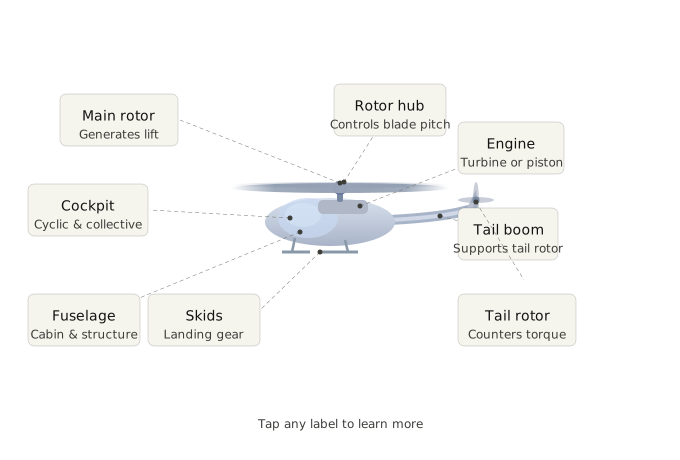
A helicopter flies by spinning its main rotor blades at high speed. Thus, as the blades spin, they push air downwards. This creates an upward force called lift. Therefore, when the lift exceeds the helicopter’s weight, it rises.
The rotor blades have an aerofoil shape. This means the top surface is curved and the bottom is flatter. Air moves faster over the curved top. Thus creating lower pressure above the blade. Higher pressure below then pushes the blade upward. This is the same principle that lifts an aeroplane wing.
Collective Pitch: Going Up and Down
The pilot controls altitude using the collective lever. Moreover, this changes the angle of all rotor blades simultaneously. A steeper blade angle creates more lift. The helicopter climbs. A flatter angle reduces lift. The helicopter descends.
Cyclic Control: Moving Forwards, Backwards, and Sideways
The cyclic stick controls direction. It changes the blade angle at specific points in each rotation. Thus tilting the rotor disc. When the rotor disc tilts forward, the helicopter moves forward. Tilt it backwards, and the helicopter moves backwards. Tilt it sideways, and it moves left or right.
The Tail Rotor: Keeping Straight
The main rotor spins fast. This creates a twisting force called torque. Without a counterforce, the body of the helicopter would spin in the opposite direction. Therefore, the tail rotor prevents this. It produces a sideways thrust that cancels out the torque. The pilot uses foot pedals to control the tail rotor. This lets them turn left or right.
How Does a Helicopter Hover?
Hovering is one of the most impressive things a helicopter can do. To hover, the pilot balances lift exactly against gravity. The rotor produces just enough upward force to keep the aircraft stationary.
This sounds simple. In practice, it demands constant small adjustments. Wind, temperature, and weight all affect the balance. Skilled pilots make these corrections instinctively.
What Happens If the Engine Fails?
Helicopters have a clever safety feature called autorotation. If the engine fails, the rotor blades can still spin freely. Airflow from the descent keeps them turning. The pilot uses this stored energy to slow the descent and land safely.
This is a standard procedure that pilots regularly train for. It means a total engine failure does not have to result in a crash.
Types of Helicopter Rotor Systems
Not all helicopters look the same. Different rotor designs suit different purposes.
Single Rotor
Most helicopters use a single main rotor plus a tail rotor. This is the most common design. It is simple, reliable, and efficient. Therefore, you will find it on most light and medium helicopters.
Tandem Rotor
Tandem rotor helicopters have two large rotors, one at each end. The rotors spin in opposite directions. This cancels out torque without needing a tail rotor. The Chinook is a famous example. Militaries and heavy-lift operators favour this design.
Coaxial Rotor
Coaxial helicopters have two rotors stacked on the same shaft. They spin in opposite directions. This cancels torque efficiently. The design produces a compact aircraft. Russian manufacturer Kamov uses this system widely.
Why Are Helicopters So Versatile?
Helicopters can fly where planes cannot. They need no runway. They can land on rooftops, fields, or ships. They can hover over a precise spot for as long as needed.
This versatility makes helicopters invaluable. Search and rescue teams use them to reach remote locations. Offshore energy companies rely on them to move crews to oil platforms. Emergency services use them to transport critical patients quickly.
Luxury travel operators also use helicopters. A helicopter charter can take you directly to your destination. No traffic. No delays. Just a fast, scenic, and comfortable journey.
Helicopter Travel in the UK
Helicopter travel is growing in the UK. Business executives, high-net-worth individuals, and event-goers all use helicopter charters. They save time and arrive in style.
London is a popular hub for helicopter travel. You can fly to racecourses, country estates, sports events, and European cities. The journey times are a fraction of those for road or rail travel.
Explore Our Helicopter Fleet
Battersea Helicopter operates a modern, well-maintained fleet. Each aircraft meets the highest safety standards. Our helicopters suit everything from short city hops to longer regional flights. View our full helicopter fleet here and find the right aircraft for your next journey.
Key Facts About Helicopters
Here are some quick facts worth knowing:
- The main rotor provides lift and directional control.
- The tail rotor prevents the body from spinning.
- Collective pitch controls altitude.
- Cyclic pitch controls direction.
- Autorotation allows a safe landing after engine failure.
- Helicopters need no runway.
Ready to Fly?
Now you know how a helicopter flies. The physics is elegant. The engineering is impressive. The experience of flying in one is unforgettable.
Battersea Helicopter makes helicopter travel straightforward. We offer charter flights across the UK and beyond. Our team handles every detail, from flight planning to ground transfers.
Get in touch today. Let us show you what helicopter travel can do for you.